What Does it Mean to be a Crow? (Part 2)
speaker-0 (00:00)
If that same objective can be accomplished through non-kinetic means such as electronic warfare, the objective is still completed but it may be much more effective. so crows find a way to achieve their objectives by working together and finding creative solutions that are maybe not the most direct path but it still achieves the objective with less risk.
speaker-1 (00:23)
you
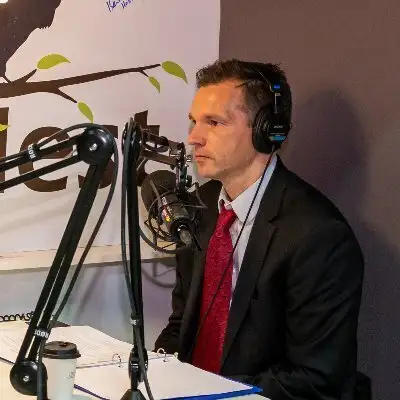
Welcome to From the Crow's Nest. I'm your host, Ken Miller from the Association for Crows. As always, it's great to be back with you. I'm very excited about this episode. I am pleased to have with me Senior Master Sergeant Brandon Smith. Among other roles, he is the EMSO Flight Chief in the Washington Air National Guard. Now today, we talk about what does it mean to be a crow, but from a war fighter perspective. For those of you who follow the show regularly, you'll know that part one of this discussion was released back on January 7th.
And back then I sat down with John Marsloff, an ornithologist and professor of wildlife sciences about what it means to be a crow, but from a perspective of crows, the bird. A few years ago at an AOC event, we had an evolutionary biologist turned intelligence expert deliver a keynote address. And he basically said that everything that we try to do in the spectrum, every capability, every effect tool is already done in nature. So while we as humans think we're so smart,
were really just copying observable nature. And so I wanted to take a closer look about how nature and our mission, the EMSO mission, come together. Now fast forward to this past December, I had the privilege of meeting Brandon at AOC 2025. His unit was winning an AOC award. I told him what I wanted to do in my upcoming episode on crows in nature, and he jumped at it and wanted to be the voice of the EMSO warfighter in part two.
So today I bring you that conversation and it took a little while, but in case you haven't been following the news the last few months, there is a lot going on in the world. And so the intent was not to leave a couple months in between, but that's just how it played out. So if you haven't listened to part one from January 7th, it's entitled, What Does It Mean To Be A Crow? Please go and listen or listen to it again, especially if you consider yourself just curious or an enthusiast, but not an expert.
Of course, there are very few EMSO experts, so I really encourage everyone just to take a few minutes, go back, refresh your memory, listen to that episode, because I think it'll enrich the conversation that I have today with Brandon Smith. So without further delay, I bring you my conversation with Senior Master Sergeant Brandon Smith. Brandon, how are you doing? And thank you for joining me here on From the Crow's Nest. It's great to have you on the show. you. I wanted to have you on the show because in the first part of our series of what it means to be a crow, we heard from
speaker-0 (02:40)
It's great to be here.
speaker-1 (02:48)
John Marsloff, who is the professor of wildlife science at University of Washington. And we had a great conversation about what it means to be a crow, taking a look at the attributes of crows, the bird in nature, and how that moniker is a really appropriate way to describe the electromagnetic spectrum operations, officers, and war fighters that we have in our community. So.
Sergeant Smith, you had the opportunity to listen to the interview and I want to kind of go over a few things that were discussed because I want to get your insight in as a warfighter and as a representative of our global electromagnetic spectrum operations community. I want to get your feedback on how we can both learn from the attributes of crows, but also how we can help educate our community and the defense sector in general about how
electronic warfare electromagnetic spectrum operations is to warfare. I want to kind of go through a few of the key points that he raised, but before I do, could you tell us a little bit about from the Air National Guard perspective, your unit and some of the work that you do in the spectrum to help our audience understand the perspective you are coming to this discussion from?
speaker-0 (04:09)
Yeah, thanks Ken. I work for the 194th Wing. It's a regional support wing. So we actually do not have aircraft. We focus on AFSPEC war, Intel, cybersecurity, as far as operations. And then I actually work in a communication squadron. So we focus on the infrastructure to make sure that everyone has their computers and their radios and their phones and that sort of thing. But within that, we have a specialized team.
that I am the flight chief of, which is the MSO flight. And this is kind of a new concept that we recently developed. And we're still going through the process of getting the organizational change request to make it more formalized. But this is a, an area that our wing commander wanted us to focus on. So that's what our, our, our structure of our wing is. I mean, a little on my background, I'm actually relatively new to electronic warfare.
Just in the last three years, I spent most of my career working more on the land mobile radio, satellite, and microwave communications to support the wing operations.
speaker-1 (05:20)
In January, I had the pleasure of sitting down with John Marsalove, who is the co-author of one of his books, Gifts of the Crow and In the Company of Crows and Ravens. And he shares insights. He's been studying crow intelligence, adaptability and cultural symbolism for decades. It was a really fascinating conversation because as he was talking, not only were there numerous references to attributes and characteristics that are relevant to our community, but he actually also mentions
the warfighter in his books because he was aware of the fact that even in the military we use symbolism to convey a culture or unity or a mission. And if you look at any squadrons or units, they'll oftentimes have animals attached to them in terms of the symbolic meaning of it. But as we talk about EW, a lot of people just don't understand electronic warfare and why we think it's so important. So one of the things that I wanted to ask you about
is you had the chance to listen to it. We spent a lot of time talking about the cognitive abilities of crows and ravens. And I wanted to get your perspective on, after listening to that, what were some of your thoughts as it pertains to what he was saying with crows possessing advanced problem-solving skills and tools that they use and they have a high degree of memory to understand the environment that they live in?
speaker-0 (06:46)
would say
that in warfare, ⁓ there's multiple ways to be able to achieve objectives, right? So there's kinetic and non-kinetic effects and psychological warfare and different things. And I think as our technology has advanced over the millennia, we're at a point where military units are dependent on these technologies for communications, information sharing, and being able to perform their operations.
And so an adversary that knows how to take advantage of that technology as far as being able to manipulate it or degrade it, deny, destroy it in some way to affect the command and control capabilities or the information sharing or the telemetry is able to achieve the objective, but not necessarily through kinetic means as you might think traditionally. So if the objective is to
destroy, let's say destroy a command and control center that can be done kinetically, but there's maybe a significant risk to doing that. There may be expensive, there may be other technical challenges, logistical challenges to being able to accomplish that. If that same objective can be accomplished through non-kinetic means such as electronic warfare, the objective is still completed, but it may be much more effective. so
Crows find a way to achieve their objectives as far as survival ability, finding food, keeping away from predators and that sort of thing by working together and finding creative solutions that are maybe not the most direct path, but it still achieves the objective with less risk. And so I think that's maybe a connection there, but also just the creativity part as far as thinking outside the box, crows are known for
being able to solve challenges that maybe some other species are unable to figure out because they're just looking at the direct path.
speaker-1 (08:43)
What's interesting is we talk a lot about in the battle space, how important sensing is. And really every asset that we put into theater, including our soldiers and war fighters are also nodes in the network. They act as sensors and we oftentimes use the term sensor shooter because not only are sometimes are some of our war fighters in charge of offensive operations, but they're also while they're out there,
they're passively sensing the environment that they live in. Crows are very similar in that with the complexity of their neural network, they really are excellent at integrating that sensory input around their environment and make not just a one-way or two-way type of sensing, but also integrating it with memory, with emotion, and with the ability to think about where...
what some of the sensing actually is meaning for their survivability, as you mentioned. Talk a little bit about how important it is from an EMSO perspective that our war fighters are able to clearly sense and understand their environment and provide that input into their problem solving so that there is no question as to what they are experiencing when they go out on a mission.
speaker-0 (10:08)
If you think about it in modern warfare, there's information sharing at all different levels as far as tactical communications, strategic communications, even the use of email and ⁓ use of the internet and that sort of thing, satellite communications, ground radio communications. So inherently, MSO and electronic warfare touch every element of the joint force. And also I would say that MSO is inherently joint because
one electromagnetic effect, let's say from the air force could have a significant impact on the army, the Navy and the Marine Corps. And so I think that it's imperative for those MSO warriors to understand their piece in the puzzle, because as you said, they are sensing the environment, but they're also interacting with the environment in a physical way. And so the analogy of the crows, one way that I kind of think about that is that
pros will work together to protect each other. if there's, let's say some sort of a threat like a predator, they'll make sure to let everyone else know. And I think that in the community, I've seen a lot of that where, especially with our unit, that's like just trying to start out as a new MSO function within the Air National Guard, that we're reaching out to our partners on active duty and other branches, active duty Army, National Guard Army.
Navy like here in Washington state. We have the big the island the growlers and so we try to get information from them and so it's a lot of information sharing It's also a pretty small community It seems like everybody kind of knows each other within this community and there always seems to be willing to help I would also just say that the association of old grows has been awesome as far as being able to have a resource for an entity that's just trying to get started to have
training sessions that are available and conferences and webinars and even these podcasts as a way to get the message out about how important this is and how critical it is in modern warfare.
speaker-1 (12:14)
I like what you were talking about in terms of working together and the communication. I want to pull that thread. But as you were talking about how dispersed the MSO community is just in the United States, let alone around the world, it's global. It's everywhere because the electromagnetic spectrum, electromagnetic energy is everywhere. What's interesting about crows is they are too also everywhere. A lot of times when we talk about animals or various groups of species, we're looking at where they're
geographically dominant in one area and how they are surviving in that one area. But crows are literally everywhere in the world. And I think it's ⁓ also a bit of a, there's an alignment there because you can't, no matter where you go, you're gonna encounter crows. Same thing, no matter where you go in warfare, you're gonna encounter the spectrum and you're gonna need crows to manage it. Talk a little bit about how ubiquitous.
that the spectrum is and the need for an understanding of electromagnetic spectrum operations.
speaker-0 (13:17)
We use spectrum every day. I think that that's one of the things where it is a bit of a challenge for us because you can't see the spectrum, but you are using it every single day. think about when you grab your cell phone, right? It is a radio. It is communicating with the tower. has GPS. has, you know, wifi. You don't necessarily think about all the technology that's being used. Wireless technology is being used. When you go to make that phone call, you just make that phone call and you expect it to always be there.
And so that's the challenge, right? Is that in a contested environment or in a conflict zone, that system that you think is always gonna be there is not necessarily going to be there and you have to be able to adapt. And I think that that's kind of another thing with the crows is that they are adapting to their environment in order to survive. because the technology, the wireless technology,
It's complicated. There's, there's a lot of moving parts. There's a lot of things to consider. One of the things that I've kind of talked about with my team is that if you think about electronic warfare and what it takes to have a really strong electronic warfare warrior or EMSA warrior is you have to understand all the fundamentals of radio and antenna theory and modulation and the wireless technology. And then after being really an expert in that area,
And then you can start working to understand how to manipulate that and how to use it to your advantage and how to use electronic attack and that sort of thing against the adversary because there's not that many people worldwide within our forces that really understand all those fundamentals nowadays because it's so complex. And so it take years to really become proficient in that and then adding the electronic warfare component. So agreed that there are
there is a need for electronic communications, electromagnetic communications around the world. But as far as like having the skillset to be able to know how to protect that, support that and use that to an advantage in a warfare context, it's highly specialized skill.
speaker-1 (15:30)
So you were mentioning how crows like to work together. And John Marsaloff in the previous episode was talking about how a lot of crows, he referred to it as a fission fusion society where they worked strongly together, but they also had very flexible group dynamics so that they could work together in pairs, but the group could change depending on what the overall mission or survivability or needs of the group. So.
they're able to adjust, adapt. It's not sticking together with the same group, but they can change group dynamics as necessary, which really rung true to a lot of what our EMSO warriors face because they might be in theater for one mission and with one unit or group of squadrons, but they might be pulled off and put to work somewhere else because there's another urgent need that arises in a battle space. And what's fascinating about what
John Marsaloff was talking about was their communication. Not only do they have a very complex way of communicating amongst themselves, but they do so in a way that other species also can listen in to understand the environment. So they can learn that a predator is in the area based on hearing two crows communicate back and forth. And my mind went through how awesome would it be if we could figure out how to get crows
as the MSO warfighter, crows talking in a way that other species, other groups understood when we alerted, hey, there's a predator, hey, there's a danger out here. Talk a little bit about that challenge of the MSO lexicon and the communication that we have as a group and how we adapt that group dynamic to solve various problems.
speaker-0 (17:22)
If you think about it, within all the branches, we have elements of electronic warfare in the Navy. They've got the Growlers and they've got other electronic attack programs and the Air Force got Compass Call, Rivet Joint and other space EW components. Space Force has EW components. To give you kind of like a real world example of the partners working with the crows, working with EMSO.
We did a big exercise last May where we had an AFSPEC war team that was trying to complete a mission where they were trying to not be discovered. They were trying to evade any sort of observation by the Red Team. And ⁓ one of my airmen had a system set up. They were monitoring the area where this AFSPEC war team was trying to get from ⁓ point A to point B about three miles away.
And at one point the team used some satellite communications to be able to transmit an image that they had captured. And the MSO team was able to get to see that on the spectrum and they were able to get a line of bearing on the team. And this AFSPEC war team thought that there was no way they were going to be detected and they were. And so in the after action report, we were able to go through that and show
what signal was detected and how and what their line of bearing was. And it was really useful because it helped them to improve their tactics, techniques and procedures so that if they're in that situation, not in an exercise environment, but a real world environment, they would be able to know what gave them away and hopefully be able to prevent that in a real world environment. So that's, think, kind of a good example of other elements of specifically the air force using
experience from the crows from the MSO team to improve their tactics.
speaker-1 (19:19)
So how important is it then for our community to be cognizant of how we are communicating so that we can share the most important aspects of what we are doing with others who are inevitably affected by our operations, whether it's just sensing or shooting or just understanding the battle space awareness, the signals in there, the threats. How important is it to have the most robust training in order to tackle this problem of
of language across specialties and skill sets in the military.
speaker-0 (19:54)
As a senior NCO, I always try to implement that concept of like train like we fight. So when we do exercises or do our monthly drills and that sort of thing, I try to identify how the training relates to real world activities as much as possible. And I think in exercises and other training events, we're always trying to focus on, what are the exercise objectives and how do we accomplish those objectives? in order...
for the military to function, you have to be able to communicate and electronic warfare, the intent is to break down or degrade that communications in order to affect operations. And so I think to answer your question, it's really taking that away in exercises helps the rest of the community to understand just how critical MSO, electronic warfare and
communication seat to command and control is. And so a lot of times in exercises, the planners don't want to take away the communications because then the rest of the exercise can completely fail. But I think it's important to do that so that we can show what the impacts are when communications is degraded.
speaker-1 (21:09)
couple years ago at an AOC annual show, we had the pleasure of a keynote speaker by the name of Dr. Eric Hesseltine provide a presentation. And Dr. Hesseltine came from the Intel community, but his degree was in evolutionary biology, which isn't a very common advanced degree for folks in electronic warfare. But his presentation was talking about how everything that we try to do in this world from a technology standpoint is already done in nature.
And so we have advanced military technology for jamming and obscuring and denying and degrading and so forth. That's already being done in nature. And one of the skill sets of an MSO warfighter is the ability to adapt to new changes in the environment, solving those problems as we've talked about. But there's a lot of things that we do that we can learn from nature. When you look at what's going on in the world, the Russia-Ukraine war,
Middle East and so forth. We're seeing a lot of dynamic change in how we fight counter UAS is a tremendously important element to winning a war and how do you how do you stop drone warfare and drone swarms? How has your unit or how have have you seen the the military address? This dynamic change and how we have to fight every almost almost on a daily basis to
And how does that relate to what we were talking about with crows being able to constantly adapt to their environment and adapt to the challenges that confront them?
speaker-0 (22:44)
So I think, you know, the Ukraine war has really been an opportunity for the U S military to observe rapid change in innovation on the battlefield. mean, I don't think anybody 10 years ago would have considered the idea of a basically a toy RC vehicle, you know, UAV, a drone having a explosives attached to it to take out ⁓ a tank. I mean,
In Ukraine, they're using $2,000 drones to take out $2 million tanks and doing it effectively to the point where, from what I understand, tanks are not even really being used because they're not survivable. so electronic warfare was used from day one in that conflict. And when the drone, the kamikaze drones started entering the stage, both the Ukrainians and the Russians were using electronic warfare as a means to counter them.
And then just like everything with the arms race, the cat and mouse, the Russians, I believe were the first ones to start using fiber optic as a means to counter the electronic warfare. And now they've even gone to ⁓ AI vision for the drones as well and other techniques that they're using. so they are innovating at just a light speed. And so.
our unit, our wing, the 194th wing in Washington state. ⁓ We recognize that and we're always trying to come up with ways to be innovative as well. Our ⁓ adjutant general, ⁓ General Welsh identified a priority of counter UAS for the state. And so all of the airmen took that on as a challenge, trying to come up with innovative solutions. within the MSO flight, we recognize that
drones are going to be an issue, whether it's domestic or overseas. So on the domestic side, the guard is responsible for what are called DOM ops, domestic operations for things like the FIFA world cup or inaugurations or super bowls. And so there's a, there's a significant concern of drones affecting those public events. Just recently, I had an opportunity to be involved in the super bowl parade in Seattle.
And during that event, were some 40 some drones that were flying in the restricted area and they had to use basically remote ID technology in order to detect them and then mitigate them. But fortunately nothing bad happened, but it very well could have. And so I think all of the public officials recognize the need to address this and the guard in Washington state has been proactive in this. The MSO flight.
identified a technology solution that was low cost easy to use and ⁓ Went through the process of implementing that so just to add additional resources we have purchased a Remote ID system and we've been training on that working with our partners within the Washington State Guard as well as active duty army and Air Force units around Joint Base Lewis McCord and so I think that's a good example of electronic warfare teams
thinking outside the box. In this case, the counter drone mission, it really does not fall under EMSO. It really falls more under our security forces. So it's more of an operational thing, but we're partnering with the security forces squadron and the EMSO flight to identify the technology solutions, identify how to deploy it, make it most effective, and then improve the ability of security teams to do their job.
speaker-1 (26:39)
I like what you were talking about in terms of innovation, trying to learn to do more with less and you're constantly trying to anticipate the challenges that are arising and looking for those outside the box or low cost solutions. I mean, that's been a critical attribute of our community for decades, as long as I've been following it. And it really does set the community apart somewhat. So in terms of lessons for our MSU community, we can learn from looking at the...
crows, you we've talked a lot about today, you know, the skills and adaptability and innovation. Just to kind of put a bow on the discussion, some last thoughts in terms of what message would you like to share with the overall community, as well as the listeners here on From the Crows Nest about the importance of EMSO and why it's essential to understand what it means to be a crow.
speaker-0 (27:34)
So I think the military is always going to be adapting to the known threat. And so I think in previous years with like the GWAT, there wasn't as much of a concern about electronic warfare. And so they did not invest in electronic warfare because the threat wasn't there. But I think in future conflicts, just with the advancement of technology across the entire planet,
there is going to be a need to focus on that. If you think about it from this perspective, we have the land domain, the air domain, sea domain, space, cyberspace, each of those domains, you have to have visibility of what is going on in those domains and then the ability to respond to threats in those domains. And I think one of the concerns I have is that ⁓ spectrum is a domain as well.
And we don't have the resources we need to effectively monitor and respond in that domain. And so we need more tools, more resources, more people trained in MSO to be able to protect that flank, basically. And so that would be what I would say as far as ⁓ my main message is that there is absolutely a need for it. There's a desire from people out there to get after this mission. We just need the support from leadership to get after it.
speaker-1 (29:02)
Sergeant
Smith, thank you so much for taking time to join me. You're a busy person and I greatly appreciate your service to the country and your service to our community. Really have enjoyed getting chance to know you and your unit from AOC 2025 and I just really appreciate you taking time to join me here on From the Crow's Nest. That will conclude this episode of From the Crow's Nest. I'd like to thank my guest, Senior Master Sergeant Brandon Smith for joining me.
speaker-0 (29:19)
Thanks, Ken.
speaker-1 (29:27)
As always, please take a moment to review, share, and subscribe to this podcast. We always enjoy hearing from our listeners, so please take a moment to let us know how we're doing. That's it for today. Thanks for listening.
speaker-0 (29:38)
you
Creators and Guests