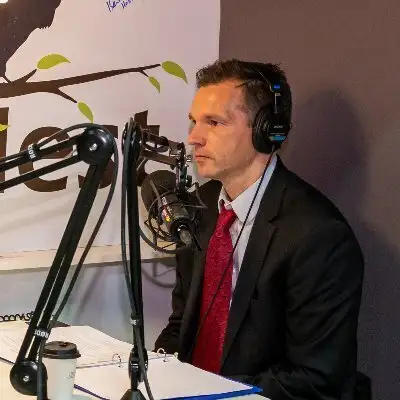
AOC Asia 2026: Closing the Gaps in Indo-Pacific EW Readiness
speaker-0 (00:00)
you
Ken Miller (00:00)
Yeah.
Welcome to From the Crow's Nest. I'm your host, Ken Miller from the Association Full Crows. As always, it's great to be here with you and thanks for listening. To begin, once again, I'd like to thank BlackArt Technologies for powering these episodes, focusing on EMSO in the Indo-Pacific region. This is the second episode. There'll be a third one coming out later this month. BlackArt Technologies is a leader in antenna and passive RF component design with experience in a wide range of military and commercial applications.
I sit down with their chief technology officer, David Dahaye, later in the show, and we just discuss some very interesting challenges and opportunities facing the global EMSO industry and market. But before we get to him, we wrap up our coverage of AOC Asia 2026 that took place last month in Adelaide, South Australia. I sit down with JP, the AOC Regional Director for the Asia Pacific region, and I am then joined by Hope Snedden, an embedded software engineer.
Who presented on an industry forum about lessons EW-enabled systems can take from the game development industry? So without further delay, let's begin and let's listen into my conversation with AOC Regional Director JP. Okay, my first guest today is JP. JP serves on the AOC Board of Directors as the regional director for Region 2, which encompasses the Asia Pacific region. He is also one of the key players in planning for AOC Asia.
JP, thank you for joining me here on From the Crow's Nest from AOC Asia 2026. It's great to have you on the show. Thank you. Thank you, Ken. And you know, the thanks for a good introduction. Yeah, like I can mention, the I'm the International Region Director representing AOC Pacific Legion. But this is just the name, you know, that this is Asia region, but you need to change the Asia Pacific region because you see that the AOC Asia is being held in Australia, but
They was wondering why they called the AC AOC Asia while the AOC Asia is taking place in Australia. So that's my, you know, that the another, you know, the homework, you know, the later. But now we are having, you know, the EOS Asia in 2026 in Australia. In connection with Adstar 2026, actually it is capture program within Adstar.
But there is separate AOC branding, AOC speakers, and AOC focused electronic warfare program. This is second event, AOC level conference, such as AOC Asia is held. the first one was held in Seoul last year, like you mentioned. but I cannot be satisfied with this. I want to keep this prestigious event continuing in the years to come. Yeah. It's very important that AOC Asia.
continues to grow and scale. This is the second year that we've had on a regular basis. We used to have it on a regular basis previously. I've talked a lot about it in in AOC business about how we need to make sure that AOC Asia, wherever it is, is on par with some of our other shows that we do because the global situation in the region is so critical to to everyone's global security. And so how we approach that region is
Extremely important and AOC Asia gives us the forum in order to do that. Now you mentioned something interesting about, you know, the show being in Australia, it's AOC Asia. And this is a an area that I think a lot of our listeners really haven't thought much about from a US perspective. Sure. As most of our listeners are, because we look at everything just, you know, basically west of of Hawaii in in the Pacific as in the Asia.
region, Indo-Pacific region. We c we come up with different names, but we're not really that well versed in the nuances that exist in that area. So could you talk to us a little bit about the vastness of the region and and how that impacts regional security? You know, the people, you know, the come along the AS Asia edits the program and then they come to the booth and ask me, what is the AOS Asia? And
Then why they call the AOC Asia like like I mentioned before, that because they are located in the Pacific region, and this region is actually quite tight in terms of the security. And we need to expand our, you know, the the concerns throughout the you know the Indo-Pacific. Let's say Indo-Pacific, Asia Pacific, whatever you say, it's okay. But if you say Indo-Pacific it includes, you know, the India.
But India is, you know, as you know, that they belong to, you know, the international region one. So let's skip that issue. But anyway, I like to call the Asia Pacific Legion. And since, you know, that there is no war in this region, but we have we have a potential, you know, the threat in this region. I cannot mention, you know, the specific country, but you know, there are so many, you know, the threat, I mean the enemies in this region that we have to.
We have to, you know, they're ready for that, you know, the if you know, the war break out, you know, the what you gonna do, you know, so in the peacetime, you know, they you have to prepare that. How
Hope Snedden (05:34)
So
Ken Miller (05:35)
d how does that impact coalition warfare? Because you know, when we have a lot of conversations at AOC, obviously in connection with AOC Europe, and that event is driven largely by we have the the NATO organization that plays a huge role, brings the countries together.
Most of the relationships in in the Asia Pacific region are bilateral or multilateral, but there's not a there's not any sort of alliance, formal alliance that kind of provides the the forum for interoperability and integration and so forth. So how does that affect coalition warfare and really partner countries working together for security in the region? Yeah, that's a that's a good point, you know, that like you mentioned that we don't have a formal alliance, you know, the
We're trying to trying to create the one, you know, the formal group just like similar to NATO. And then as far as I remember, and then the former Japan, you know, the Prime Minister suggests these, you know, the types of you know the alliance, whatever they call, but it did not happen because you know, the political issues, because there are strong resist from the country we consider as you know, the enemies, but so it could not happen. But it has to be
there in our region. Otherwise, you know that we cannot the prepare the some you know the something appropriately. But if there is a some formal you know the group just like a similar to NATO then we can share the some sensitive information and we can you know the ready for that immediately. But of course we do have some you know the US forces in Korea, US force in Japan.
And then throughout the you know the region, but it's not enough to protect ourselves. We have to create some military the alliances. Of course, you know that the the there is some economic alliances, so-called even the ASEAN, but they discuss some of the economic issues all the time, periodically. But there is no military alliance in this region, so it should be there. But you know, the using the USA is it's kinda you know, there's some
types of you know the alliances. You know that the if we held you know the AOC Asia in Korea, then the other country come to the Korea and then you know the they discuss about the, you know, the rather than not the whole military issues, but specifically focus on the EW issues, but it's okay. You know, still we are forming some, you know, the types of, you know, the alliance, right? So the it is important to have the, you know, the AOC Asia in our region.
bring back together. That was my, you know, the ultimate goal, you know, the learning for the you know the international region to director. I have pledged that I have you know the goals to achieve. And one of the goals is AOC Asia bring back to our, you know, the region. You know, like I mentioned that EW Asia was there before COVID. But that's a little bit different from AOS Asia. EW Asia managed by the Singapore chapter and then, you know, but it is only focused on small, you know, the topic and then
Taking place only in one country, Singapore. That's it. After the COVID, there is a long term, you know, the recession. And now we have, you know, the we have to bring back the AOC Asia again in our region. I'm pleased about that. That's a great segue. AOC Asia twenty twenty seven is gonna be back in I would assume it's in Seoul in South Korea.
where it was last year. and I believe there's some talks about it being somewhere else, either Japan or somewhere in twenty twenty-eight. As the regional director for AOC, you're going to be really shaping this event for the next couple of years. What would you like to see outside of just the geographic location of the event, but in terms of the growth of the event and and the topics that we talk about, how do you want to see AOC Asia grow between now as AOC Asia?
2026 wraps up and we start to plan for next year. I'll tell you what, you know, the when I you like I say, when I first, you know, the start as a you know the international region to directors, you know, the I, you know, they just you know the land from the AOC Europe. They rotate the venue every year in the different places. This year is Helsinki, next year is, you know, the Portugal, something like that. And that's why I like to rotate the venue here and there every year.
Let's say in Korea 2025 and 2026 in Australia. Two years ago, I was here to suggest this, you know, the idea to the AOC, the angel chapter board members, and they agree with that. And then they I'm happily they accepted our my suggestion. Then that's why I we are having you know the AOC Asia in Australia this year. And next year, because you know, the as you know that the we don't have many chapters in
Asia region, only five chapters. And then they don't have the any experience before. So they are not willing to host AOS Asia. So th my plan is, you know, the since this region, I just, you know, the suggest that every other year, let's say in connection with the ADEX, ADEX, you know, the taking place in the other years, let's say 2025, 20 27, 2029. So
in connection with ADEX, you know, just like ADSA in here in Australia, we like to host AOC Asia in other years. And then and then you know the the other years, let's say 2028, Japan, you know, the willing to host the AOC Asia in 2028 and 2029, if there is no chapters like to host you know the AOC Asia, then we take again.
You know, because there is the index, you know, the 2028. But I am still negotiating with the other chapters. Also, I mentioned about this yesterday, the chapter meeting chapter officer meeting, that you know, if there is any you know the chapter like to, you know, the host, you know, the AOC Asia in their country, then it's okay. It's open to all chapters to host you know the AOC Asia. But if there is no one to hold, then you know the R okay.
lose the chapter will take, you know, the the AOC Asia in two thousand twenty nine. And hopefully well luckily, you know, the Taiwa Taipei chapter will host, you know, the AOC Asia in two thousand twenty nine or two thousand thirty. That's what it is. You know, the my plan is, you know, the long term plan is like that. I think that I speak for everyone in the AOC. We we want to see AOC Asia on par with with our shows in AOC Europe and and the US.
I've been a big proponent of seeing AOC Asia, you know, we're trying to get a similar event started in South America and Europe and connecting these events because as we talk about modern warfare, the world is connected more today than it ever has been in the past. And so we need these read these strong regional conferences, these summits to really pool together our global leaders in EMSO to talk about these problems. so I really do appreciate all the hard work you're doing.
All the reports that I've been hearing about AOC Asia this year has been fantastic. Your leadership is appreciated and we're looking forward to 2027. So thank you so much for joining me, JP, and looking forward to seeing you again soon at AOC. Thank you, Ken. Thank you for giving me this chance to introduce AOC Asia and then hope to have the, you know, the productive, you know, the AOC Asia in the years come. Thanks. Sounds great. Thank you so much. I appreciate it.
Thank you, JP. It's always great to hear from you. My next guest is Hope Snedden. She is once again an embedded software engineer from Design Works, and she participated in an industry forum discussing what we can learn from the game development industry. Let's listen in. I am pleased to be here with my next guest, Hope Snedden. She's an embedded software engineer at Design Works, and she participated in an industry forum.
To discuss lessons EW enabled systems can take from the game development industry. Hope it's great to have you here on From the Crow's Nest at AOC Asia. Thanks for joining me. How's the conference been so far for you?
Hope Snedden (13:59)
Thanks for having me. Yeah. the conference was really insightful. It was great to hear from a lot of other leaders in the industry and also a lot of engineers that are really just trying to prioritize innovation in a time where, you know, the resources available to us to do so are quite limited. There's a lot of talk around AI and some of the sort of encroaching technology there. And so I think being able to discuss what that might look like and how we might go about implementing that in EW systems was really interesting.
Ken Miller (14:28)
Now, our our listenership, we actually draw quite an audience from Australia. So many people might know you, f many of our listeners might already know you, but for our listeners here in the United States, they might not be familiar with you or your company d design work. So could you tell us a little bit about yourself and your company so that we can understand a little bit more about what you bring to the discussion on software defined capabilities?
Hope Snedden (14:48)
My background is more so in autonomous you know, aviation. so in the past I've worked on a few different defense vehicles related to trying to implement, I guess, multi-sensors and and sort of a a larger data fusion picture for autonomous vehicles to support other defense assets and networks. And what I've really come to learn, sort of working through some of the platforms I've worked on at Boeing and also with DesignWorks as well, is
There's just a lot of potential for us to be leveraging more research and development and more innovation from external industries. And there's just this sense in defense that I think we always have to be sort of redefining the wheel for ourselves in terms of developing our own innovation and our own research and development. And it's just not the case. I think, especially in the past couple of decades, the idea that, you know, military.
is the custodian of this next gen technology and and we have to release it if back into external industry is kind of just inverted. And it really is the case that we should be leveraging it from civilian industries and existing private companies and being able to apply it to the military context.
Ken Miller (16:01)
That's a great point. You mentioned for decades the newest innovation would be would come out of the military and be adapted by commercial. And now we're seeing that completely different. And a lot of that has to do with how is commercial going to respond to military issues with scale and adaptability and so forth. You mentioned that the topic of your discussion was lessons that we can learn from game development. And obviously what we see happening in the gaming world.
whether it's AI, cognitive systems, unmanned systems, counter capabilities, they are driving a lot of that innovation. But it it's also something that's very fresh and new in terms of how the military looks at what's out there from the commercial sector, is something like the gaming world. Yeah. How specifically is the gaming world changing the conversation on software-defined capabilities?
Hope Snedden (16:54)
Yeah. So I think really what's occurring from sort of the research that I did and and looking into the parallels in technology between the two industries is the game development industry fundamentally, you know, reinvests between 15 to 25% of their revenue back into RD because their product is basically a software-defined sort of problem set related to innovation. And so what that means is, especially in the context of the rise of first-person shooter games and open world games.
is they're fundamentally solving very similar problems. They're solving things like persistence management and contributors in a very complex world state and how you go about managing and updating and allocating resources associated to tracking those things. And then you've got that in the combination with sort of non-deterministic, non-playable characters because they're fund fueled by AI algorithms in the background or they're doing very complex, somewhat unpredictable things.
And so I think in terms of autonomous platforms where, you know, you really kind of need to have this common reference point of what the platform thinks the external world state is, you can really apply some of these data oriented ways of managing that complexity that the game development industry has invested billions and billions of dollars into.
Ken Miller (18:15)
Very interesting point of reallocating about 15, I think you said 15 to 25% of revenue for into RD, which is far more than we have in in in the traditional military defense industries. When you look at software-defined capabilities, obviously they are all the talk, but they're not a panacea. In other words, they're not gonna solve every problem just by software. So when you look at how industry is responding to some of these challenges.
What really keeps you up at night in terms of can industry adequately provide what the military sector needs? And vice versa, can the military sector use what the commercial technology has in a way that it's meant to be for, you know, executing a mission v and and returning home safely?
Hope Snedden (19:03)
I
definitely think that's that's a two-part problem as well. I think the first part of that problem is, you know, with the rise of software-defined platforms in the military, we've really seen our ability to manage that complexity and and manage the the sort of bureaucracy that comes with projects like that. it hasn't really risen to the same level. And so I think platforms today like the F thirty five, they're taking, you know, ten times longer to certify for airworthiness and they're taking thousands and thousands and hundreds of thousands of pages more.
design documentation to reach production. And so we need to be able to first of all, I guess, address that lack of agility in terms of delivering capability. But then on on the flip side of that, I guess to be able to implement external innovation and external technologies like that of the gaming industry, we have to also be really smart about how we go about segregating information and our information management in terms of
what is that layer of software or open source development that we can keep public and we can continue to leverage? And then what is the layer that, you know, we need to keep quite tightly coupled to the the military sort of capability and and protect that. And I think if we can do both of those things well, which you can see a lot of industry disruptors like Andrew are doing, you're able to leverage just an insane amount more productivity that comes from
people who don't even work in defense and people who are working on, you know, amazing technology elsewhere.
Ken Miller (20:35)
Recently I had the opportunity to participate or observe a NATO exercise called Thor's Hammer 2026 up in Norway. And a lot of the conversation among the participants up there as looking at kind of coalition warfare and sharing technology interoperability in this age of software-defined technologies, th they talked a lot about this notion of open source and data sovereignty and how with software today.
We're collecting so much more data and we're having to share so much more data that we have antiquated data sharing techniques and policies across countries. From AOC Asia perspective and the conversations that you had at the show, where does data sovereignty and data sharing kind of come into the conversation with when we talk about innovative technologies and that kind of that next generation of the fight? How we can get countries talking to one another.
A little bit better, a little bit faster, with a little bit more trust, because obviously these are national security technologies, but if we are not talking together, we're not fighting together. And so how do we kind of get over that hump?
Hope Snedden (21:47)
That's a really good question. and it's definitely not a simple answer, I think.
Ken Miller (21:53)
that that's why I'm the host and you're the guest. I
speaker-4 (21:55)
Yeah
Ken Miller (21:56)
get to ask the question, you'll have I stick you with the answer.
Hope Snedden (21:59)
Yeah, yeah, for sure. I think a lot of it comes down to especially in the autonomous space. What I see needs to occur is there needs to be an element of system architecture design kind of dedicated to to modularizing and isolating components, especially in the software space, so that you can have these kind of, I suppose, almost lower levels of assurance in your system that you're able to
definitively say you're isolated or compartmentalized from the rest of your system. I think that's that's really important. And that was some of the discussion that came out of after the presentation yesterday as well was a few sort of defense related people came up to me and had questions around, you know, we're trying so hard to do this and implement this in in current platforms and really struggling. And I think
You know, an element of it is is fundamentally an architecture question and whether or not we need to go about sort of revising some of that software architecture to be able to facilitate.
Ken Miller (23:00)
So when you talk about architecture, you know, when we talk about advanced systems traditionally, we quickly talk about the platform, the system that we envision seeing f you know, fly to the fly into the fight or or you know, driving the fight. With software, it's not really about the system that the software is housed on, but really the there it's a whole different way of thinking of development when you start to look at the foundry and the creation of the chip and security,
secure processes and things of that nature because you want to develop a a a board that can go into multiple systems to do that capability. One of the understandings, of course, among software developers, I'm sure similar to yourself, is every chip is going to have a bug. And, you know, anybody who has a Google phone or Apple phone knows that you just get downloads all the time for updates to fix bugs that are that are found. And everything is going to be fixed incrementally. This is a whole
new set of challenges for innovators when you start to think about supply chain. I mean, we've always had to think about supply chain, but it's it's a much different conversation when you're dealing with foundries and chips and and fixing bugs and things of that nature and secure supply chain. As a global EMSO community, then what are some of the best practices you recommend to mitigate the risk of security, of making sure that the systems are tested and evaluated properly for the fight.
And scale, what are some of the best practices we need to be paying attention to and following as a community as we learn from the commercial sector?
Hope Snedden (24:34)
I think an element of it is definitely once again information management. but in terms of sort of the tangible things, I think the practices around those sort of software element isolations in combination with things like data encryption and and zeroization of platforms as well is really important. And then separately, I think a lot of what is currently happening while we're figuring out, you know, best practices and being able to do this in
in military contexts is the ability to even branch off of open source software or completely generate sort of a a snapshot in time that we can then isolate that software on on a network in in a controlled way so that we have, you know, a a set of that functionality available to us that we can then sort of periodically evaluate over time and and update but is not readily connected to sort of the outside world. I think
I've seen some instances of that being done really well. And there's definitely work to go there in in what that looks like long term and for, you know, more sensitive capabilities in general. But I think just the fact of the matter is that we as an industry need to figure out what that looks like and how that works because we're just not able to invest the resources and the time into generating the technology that we need to stay competitive.
Ken Miller (25:57)
So one last question in terms of AOC Asia, this is an annual conference for AOC, and obviously it moves it moves around to different locations. This year it's in Australia. I think next year it's going to be in in South Korea. last year it was in South Korea. Coalition, when when we think about that region, the Indo-Pacific region, and the threats there from all up and down along China, whether it's Taiwan, South China Sea, other global unrest that's happening, even outside of China and and
elsewhere in the region, the coalition environment in that region is also different than anything that we face over in the US or in in in in the West with Europe. So from an AOC Asia perspective, how can we improve upon coalition and coalition warfighting and and interoperability amongst partner countries like US, Australia, Five Eyes, and other regional partners in the Indo-Pacific area?
Hope Snedden (26:54)
I think a lot of this stuff kind of lends itself naturally to being able to do that better. I think if you're able to modularize your systems better and use at least, you know, a segment of what is more shared software or or shared developed innovation. If you're able to sort of plug and play with those things in your system, you're fundamentally able to share it with, you know, coalition members. And I think that's really important. And I think it's
it's kind of this positive feedback loop of when we're able to figure out better what that looks like and how that's implemented. It just unlocks this ability to be able to work closer with with our coalition partners.
Ken Miller (27:33)
Well, Hope, it it was great to have you on the show. Thank you so much for taking time. I know you've had a busy week at AOC Asia presenting and of course, you know, day jobs don't stop in the in in the middle. So really appreciate you taking time to join me here on From the Crow's Nest and really hope to have an opportunity to to meet you in person at a future AOC event. Hopefully AOC Asia next year will work out for me to be in person there. But really do appreciate you taking time to join me here.
Hope Snedden (27:57)
Thanks so much.
Ken Miller (27:59)
Thank you, Hope. It's always great to hear outside the box thinking and fresh ideas to address the complex MSO challenges we face today. I really appreciate your perspective and thank you for taking time to join me. When we return, I welcome my final guest to the episode, David Dehaye from Black Art Technologies.
All right, well, welcome back. for my final guest. I welcome David Dehay, Chief Technology Officer from Black Art Technologies. Let's listen in. All right, for my final segment today, in today's episode, I welcome David Dehay. He is a chief technology officer from Black Art Technologies, one of the industry participants at AOC Asia twenty twenty six. David, thank you for taking time to join me here on From the Crescents. It's great to have you on the show.
speaker-2 (28:45)
Thanks Ken, appreciate it. It's quite an opportunity and I appreciate the opportunity to be here and just kind of promote what we do and how we see things in the RF industry.
Ken Miller (28:55)
And I want to thank Black Art Technologies because with your support of our podcast, you were able to get from the Crow's Nest into AOC Asia and to InfoPack 2026 and help us engage the audiences there. And we really appreciate your support. And so I wanted to have you on the show today to share a little bit about the industry perspective of many of the topics that were covered at AOC Asia. And of course, in our previous episode, we heard
From the Australian AOC Australian chapter president Nathan Johnson. We heard from Crystal, who was a featured speaker on I think day one, talking about how China is building its MSO force. And earlier in this episode, we've heard from Hope Snedden talking about how the gaming industry can.
change the way the industry works and so forth. And so there's been a lot of crossover between how government is addressing these challenges and industry. And so I have you here to talk about the industry and looking forward to kind of having a good conversation on this with you. So with that, AOC Asia 2026 is in the books. a lot of good discussion happened over the course of the of the three days there. and a lot of the topics focus on the kind of the unraveling security environment into the in the Indo-Pacific region.
So, from an industry perspective, what some were some of the messages that were most impactful to you for growing and securing the regional defense base? You, you know, Black Art technologies in South Australia. So you're right in facing this existential threat on a daily basis. And so what are some of the messages that were most impactful to you from an industrial-based standpoint in terms of responding to this threat environment?
speaker-2 (30:35)
Ken, so this is a tricky question and I think from our perspective, I am personally an engineer deep from my heart. So I try to solve problems all the time and I guess I come and listen to what's being said and what I hear from a technical perspective on what am I hearing first of all for the company, but also for myself as a user. Now, as a company, we actually have exposure in a wide range of industries.
defense is obviously a big one for me. It's a passionate one. But we also hear a lot about the mining industry and the IOT industry. And the thing is, it's almost like the thing that frustrates me the most, if I can kind of be that blunt, is the mixed messages that I feel we are getting as community in Australia, that of course in the defense industry and with the AOC and everything that's happening there, I'm fully supportive of the concerns about China and the concerns about what's happening in the inner Pacific. For instance, we cannot
This is just blunt from, comes from top down. We can't buy anything from China, which I fully support. do that as well. We have limitations of what we can do, who we can talk to and all those things. And that's a hundred percent working for us because we know as Australians, we need to get sovereign capabilities. So that's a big thing that we can get manufacturing back here. However, if I think about the other industries that we as company also get exposure to in IoT and consumer space, 4G, 5G.
Our biggest trading partner is China and that disconnect between what we hear from that sort of market and from the general politicians. with all due respect, like we have extra flights coming now from straight from Adelaide to China and then big announcements. We're happy. This is all going great. But then we sit in the defense industry also here in Adelaide as a do not talk to them, do not share any documents with them. And it's really hard. It's really hard to kind of work your way through that.
mixed messages. But for us as a company, we're fully supportive of what the fence needs to do. You read the news, you see the realities in what's happening with attention is building. It's just the disconnect is really confusing for all of us. And it kind of stands out that the message isn't clear and we need to be probably a bit more vocal about what is the reality of what we see is coming our way.
Ken Miller (32:55)
Well, and I think sometimes the the mixed messaging is a result of just a lack of clarity in terms of the right pathways to solving the problem. I mean, there's a lot of different insights. There's a lot of different research being done. On the first episode, we we we had a subject matter expert from Taiwan talking about how you know how
you know, their perspective. And then you have other countries in the region have completely different dynamics that they have to navigate. And so it gets complicated really quickly. And now Black Art Technologies, though, is it's you're you're a leader in RF and antenna technology. And you have global customers. And so you're not just always focused on the on that bilateral element. You're you have a global capability. And so when you look at the global defense industrial base for EMSO
Stepping outside of the Indo-Paycom region, even when you look at the West and Europe, you know, there's this we're driven by the fact that for decades there was this tacit assumption that the EMS was a permissive environment. And so there wasn't a lot of investment, whether you're looking at Europe, the US, or other countries, it kind of took a backseat to some other exquisite technologies that were out there. And now we're seeing, hey, everything begins and ends with the spectrum.
And that elevates and puts a spotlight on companies like yourself that are focused on RF and antenna technology. So we talk about not being able to lose ground anymore to peer competitors. So as a company like Black Arts Technologies, how has this chaos of the EMS in today's world and in today's threat environment, whether it's complexity, congestion or congestion, how has that impacted the ability of Black Art technologies?
to meet the needs of your country's military as well as partners and allies who you join in operations.
speaker-2 (34:50)
way you state the question, it's actually just ringing so true to my personal, because when I studied, is now 20, 24 years ago, I had an interest in antennas and people were saying, well, this is old tech. The antennas is no longer relevant. And I just stuck to the science because I really had a passion for what I learned in the physics. And over the last five years, I mean, we've been doing what we do for 10 years now, but for the last five years, we've really seen people.
take a liking in wireless and again, the consumer space obviously as well, with drones is just one of the perfect examples how you need an antenna and you need good antennas to be better than the other guy, so to speak. But the big thing for us is the simple feature of broadband to wideband antenna. So if you think about the kind of technologies we had five, six years ago, 2.4, 5.8 gig, you had two bands, that was it. That's all you needed. So
antennas were specifically designed for those specific frequencies. These days they go through the whole spectrum and I just, in a casual sense, often tell people that if somebody has ill intentions, why would he follow the regulations in going for 2.4G transmitter? He could do anything. We need to be ready. And what we see with our competitors is we used to design antennas for them in that kind of industry where it was specific for a band. That's no longer the case.
We want to have an antenna that is frequency agnostic. So just have something that goes from very low to very high. And we've been working on designs that go for 20 to one bandwidth, just so that the antenna is there, it's ready. And then whatever comes our way, the antenna is no longer the limiting factor and the cables also, we make them that they are ready for higher frequencies. So even if somebody says, I only need it for, let's say 2.4 gigs, now we'll do a good job, make it work up to eight, nine gig anyway.
just so that we are ready for whatever still comes. So it has impacted us, but definitely for the better. The other thing is just time to market. So we had a stand at the expo and also there was one earlier this year. The amount of inquiries for low cost, fairly easy to make, but still high quality, that's out there, which is quite different from when I was a young engineer. Every defense antenna had to be pristine, perfect, perfectly, and it will last forever, which is great.
But there's no time anymore for that. You want to get to the point where you make products that are still high performance, but it needs to be easy to make quick, fast and lightweight because now you don't know where it's going to get you. So the way we have to design our products needs to be ready for a wide range of applications. And that's what we at Blackart Technologies really focus on is find something that is not as perfectly made, but is made for what it's needed for. then
Disposable is actually the word we use these days. So disposable high quality antennas.
Ken Miller (37:44)
And that kind of segues to my next question. You know, you mentioned about producing or developing and creating technology for what's coming up in the future on the horizon. And I was j I just recently presented at another AOC conference recently, and I talked about this notion of this we talk a lot about speed of relevance. It's a common term in in our lexicon. And I didn't going into my presentation, I didn't really know what that meant because there were so many different definitions, but I kind of I made the point that I believe speed of relevance is the pathway.
To a solution before you know the problem. And that seems to be kind of based on what you're you're talking about in black art technologies, is that's kind of how you think. You're making sure that you have a solution available before you know exactly what the problem is. And that's critical. So specifically, you know, what does black art technology bring to the table in terms of game-changing capabilities for coalition partners for Australia that people need to understand that not just for what your company produces, but
This is where industry is going. You're going to see a lot more investment and focus on RF antenna technology because as you mentioned, we now realize that this is where, because the decades where we underinvested, this is a vulnerability and this is where we are seeing an an emerging threat.
speaker-2 (39:00)
It starts so deep actually because one of the frustrations I have and one of the passions I have is education and mentoring. So I'd love to tell people about antennas and I love to tell them about how it gets designed and where you can actually make them. For us, the contribution goes from, okay, let's go for the fundamentals of the design and a silly example, and it's not silly, it's serious, but 3D printing. It's such a powerful tool. And then a lot of people think we're 3D printing. So I need to buy something that is like,
hundreds of thousands of dollars worth. You need to find something that is a good quality solution, probably still plastic-based, but then can get the result that you want for the final product. And we actually have evidence of significant multi-spec vibration tests being passed on a solution that has elements of 3D printed bits and pieces in there. getting the mechanical designs. Now, yesterday I was actually talking to a colleague and he said to me as well that
antenna engineering actually is more mechanical engineering than electrical engineering, which is quite true. So for us, the value add becomes finding lightweight or compact solution that doesn't break the bank that people are willing to pay one, break it and get another one going before, rather than investing, let's say an antenna that's worth $10,000 earlier should now be less than a thousand dollars for the same antenna. So we can actually get more of them out quicker.
Ken Miller (40:24)
And scale is very important these days.
speaker-2 (40:26)
yeah. that's, that's unfortunately, this is kind of where I do take, I observed the way that China does production. And I think we need to learn from that because some of the antennas in my early days in South Africa, we would have made a big order of 200 antennas and it was a big deal for us. And it would take us a month or two to make those. The scale we're currently being asked to do is, that kind of number in weeks. So you need to go faster. need to go quicker.
But we need to keep the quality and the performance better because obviously this is 20 years later. We know more about how to make an antenna. We have better tools. So the challenge is better performance at scale with lower cost products. And that's what we do. actually managed to get that done on a specific passion for us is the simple antenna lock periodic dial polarize, cavity back spiral antennas. Those real classics, they're not.
classics and old, they're classics and they get new life and we're actually making new versions of those same antennas that we still try to outperform what has been done for decades.
Ken Miller (41:29)
So now that AOC Asia twenty twenty six is wrapped up. it was a great event. we're staying focused on the region in on from the crow's nest here as we proceed to attend, thanks to your support. We're going to InfoPack 2026, which takes another look at it more from the US Indo-Pacific perspective. but we are going to continue this conversation. So when you but and then next year's AOC Asia is going to be back in Seoul, South Korea.
So over the course of the next year, when we look into the future here, from your perspective, what are some of the topics that are critical for stakeholders to address here in the coming months as we kind of take the momentum of these events and these conversations and try to produce some real deliverable and change for the global MSO community?
speaker-2 (42:19)
It feels like it's a boilerplate answer, but it's so real that we need to get the supply chain and the education chain going so that we have resources like humans that can actually do the things, design work and manufacturing, and the supply chain. We all get ready to just keep making these things. Unfortunately, in Australia, it's been a big move over the last 20 years to get manufacturing done overseas. We're just re-educating ourselves and getting all that back in-house again.
so that we can do our own raw components from material through to designing it, well, designing first locally, getting it manufactured here and through to that. So it's the whole industry supply chain and value add. It's getting the accreditation, really getting the supply chain local for us in Adelaide. Even then it is handy to have it just here in Adelaide. So it's just building that industry again from first principles and it's an ongoing mission.
I really feel it's happening and it's quite enjoyable to, you know, as an industry, we're supporting each other and where we get it wrong, rather than just say, you get it wrong, I'm going to somebody else. We learn together and we then get it better. And learning in-house means that we can, you know, just self-educate and go forward. So it's an ongoing thing. And I hope that next year, this time we will have conversations, we'll have a few more suppliers that now know how to do this. Got some.
issues resolved, we learned, better, and we keep going forward.
Ken Miller (43:47)
Well, David, this is great insight. Really appreciate you taking time to to join me here on From the Crozeness. Thank you once again for your support for our From the Crozen podcast. It was great to meet you at AOC Asia. And I'm looking forward to staying engaged with you over the year and, you know, seeing you at other opportunity industry discussions here over the year. With that, I want to thank you for joining me on From the Crows Nest.
speaker-2 (44:10)
Thanks again, I appreciate all your support and all the work that's been done in the industry.
Ken Miller (44:15)
Thank you.
speaker-2 (44:15)
Thank you.
Ken Miller (44:18)
Will conclude this episode of From the Crow's Nest from AOC Asia. I want to thank my guests, JP, Hope Snedden, and David Dehay for joining me, and of course for Black Art Technologies for powering these episodes. In our next episode, we stay focused on the Indo-Pacific region and we'll be coming to you from InfoPack 2026 in Honolulu, Hawaii, which is taking place in early September.
As always, please take a moment to review, share, and subscribe to our podcast. We always enjoy hearing from our listeners, so please take a moment to let us know how we're doing. That's it for today. Thanks for listening.
speaker-0 (45:09)
Okay
Creators and Guests